Why In-House Counsel are right to be cautious about using the wrong AI
Don't let the wrong AI become part of your workflows.

Why In-House Counsel are right to be cautious about the wrong kind of AI
AI is finding its way into legal workflows whether organisations formally adopt it or not. Increasingly, it enters through individual use: in-house counsel and commercial teams relying on free, general-purpose tools to help summarise, review, or “sense-check” contracts under time pressure.
This trend is understandable. Contract volumes are rising; resources are finite and expectations around turnaround times continue to tighten.
Alongside these pressures, we are all exposed daily to stories and claims around AI’s astounding capabilities and predictions that AI will replace us mere humans any minute now.
In 2026, managing how AI is used matters far more than whether it is used at all.
For in-house counsel, caution is not resistance to innovation. Rather, it is an expression of professional responsibility.
The Real Risk is not Speed, it is Accuracy Without Accountability
Construction contracts are not generic legal documents. They are dense, heavily cross-referenced instruments that allocate risk across multiple parties, time horizons and project conditions. Small drafting changes can have outsized consequences, particularly in amended standard forms such as FIDIC, NEC, or heavily amended EPC and D&B contracts.
Generic AI tools are not built to operate in this environment. They are designed to perform broadly across many domains, not deeply within one. As a result, they often struggle with precisely the issues that matter most in construction contracting subtle deviations, embedded amendments, and risk that only becomes apparent when clauses are read together rather than in isolation.
The concern for in-house counsel is not that these tools are imperfect. It is that they can appear confident while being wrong, a combination that creates exposure rather than efficiency.
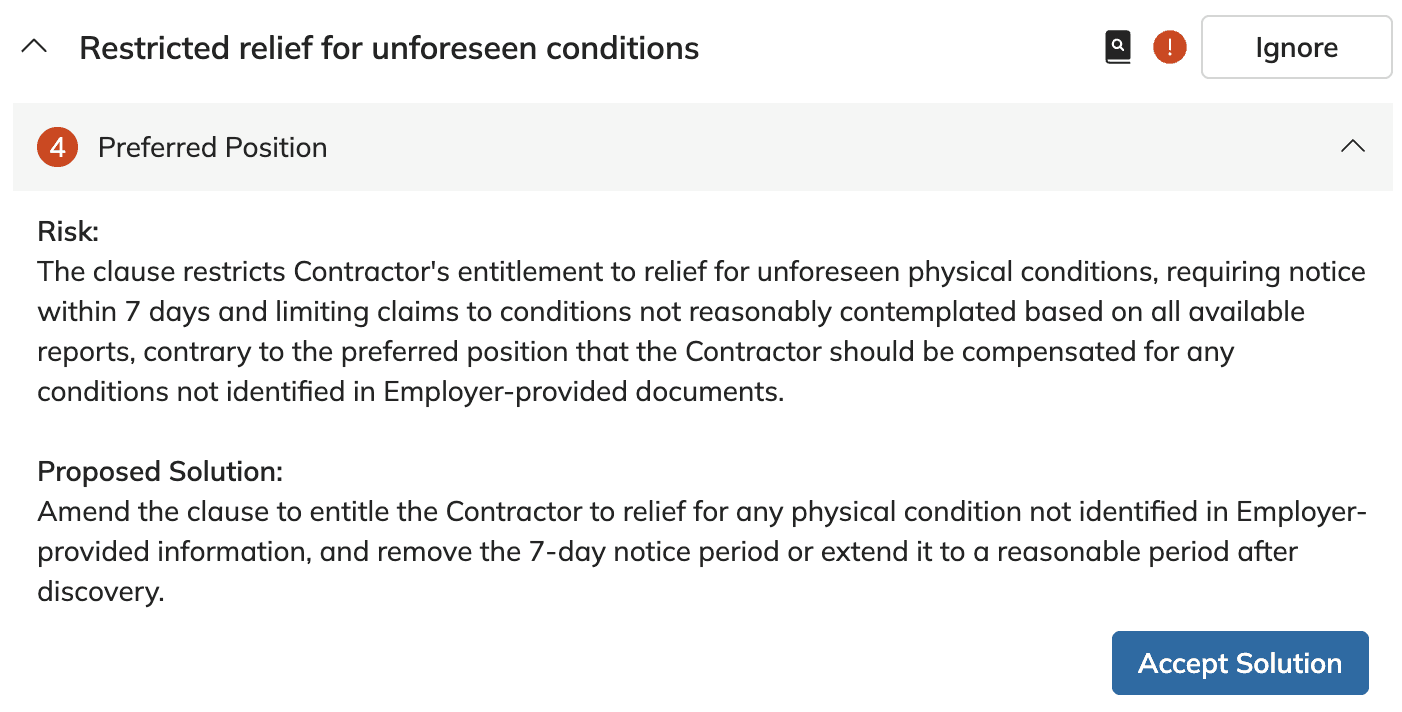
Responsible tools are domain-specific and keep the user in the loop when it comes to decision making. For example, Contrafly will always give a user its suggestion, the rationale behind that suggestion and then ask the user to make an informed decision to accept, ignore or amend that advice.
Specialisation is not a Luxury, it is a Safeguard
General-purpose AI tools tend to treat contracts as interchangeable text. That approach may work for high-level summaries, but it breaks down when applied to documents where meaning depends on structure, precedent, and industry-specific context.
In construction, this is particularly acute. Understanding whether an amendment meaningfully shifts risk often requires reading across General Conditions, Particular Conditions, schedules, and technical documents not to mention a myriad of applicable legislation and regulation.
Identifying and resolving risk in complex contracts requires familiarity with how standard forms are typically drafted, negotiated and administered. This is why a new category of AI tools is beginning to emerge: domain-specific systems built around particular industries and document types, often with direct input from practising lawyers.
These tools are not designed to replace legal judgement. They are designed to reflect how in-house counsel actually thinks by identifying and categorising risks and deviations from market and organisational norms. They then present those issues in a way that supports professional analysis instead of seeking to substitute it with a poorly considered ‘quick fix’.
Trust Depends on Boundaries, Not Capability Claims
For in-house counsel, adopting AI is not just a technical decision, it is also a governance decision.
Questions around data security, confidentiality, auditability, and explainability are as important as output quality. In-house counsel needs to understand where an analysis comes from, what it is based on, and how their documents and commercial positions are protected throughout the process.
Trustworthy AI in a legal context must therefore be intentionally constrained. It must operate within clear limits to reinforce the principle that accountability remains human. To facilitate adoption, it must provide data that can be integrated into existing workflows and be accessible through existing platforms, particularly common enterprise tools like MS Office.
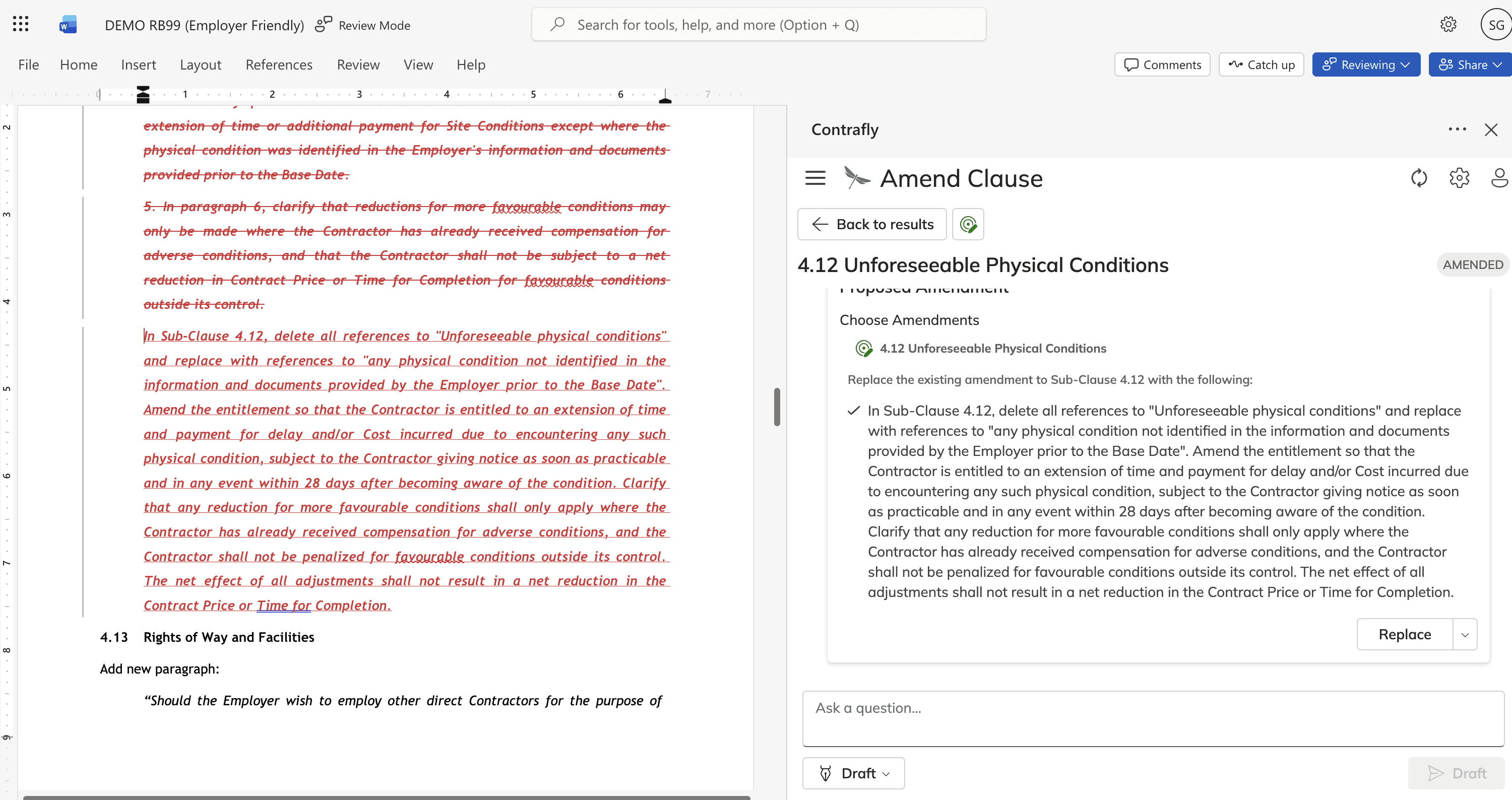
Tools that promise too much tend to erode trust. Tools that are explicit about what they do, and what they do not do, are far more likely to earn it.
Augmentation, not Automation
The most realistic opportunity for AI in construction law is not full automation. It is augmentation.
Used carefully, domain-trained AI can reduce time spent on repetitive review tasks, improve consistency across large contract portfolios, and help in-house counsel surface risk earlier in the negotiation process. It can also support commercial and procurement teams in conducting preliminary reviews, allowing legal resources to focus on higher-risk and more complex issues.
Crucially, this approach does not remove judgement. It creates the space for better judgement by reducing noise, fragmentation, and avoidable manual effort.
Where is AI Heading?
AI adoption in construction law is still at an early stage. That is a positive thing and provides an opportunity for those looking to adopt AI in the near future.
It gives in-house counsel the opportunity to shape how these tools evolve by ensuring they are built around professional standards, industry reality, and appropriate restraint, rather than generic capability or marketing claims.
The future should not be about transferring control to machines. It should be about increasing confidence that technology can support in-house counsel without compromising transparency and accuracy whilst being genuinely aligned with the complexity of construction contracting.
That is the direction tools like Contrafly are working toward: AI-assisted contract review and amendment designed specifically for construction documents, grounded in standard forms, and built to support, but not replace, legal judgement.
Progress in this space will not be measured by how much human involvement is removed, but rather by how effectively technology helps professionals do their jobs with greater clarity, consistency, and confidence.
Follow Contrafly on LinkedIn and be part of our story as we launch Contrafly: an innovative, construction focused tool delivering the promise of AI to construction contracts without compromising accuracy and consistency.